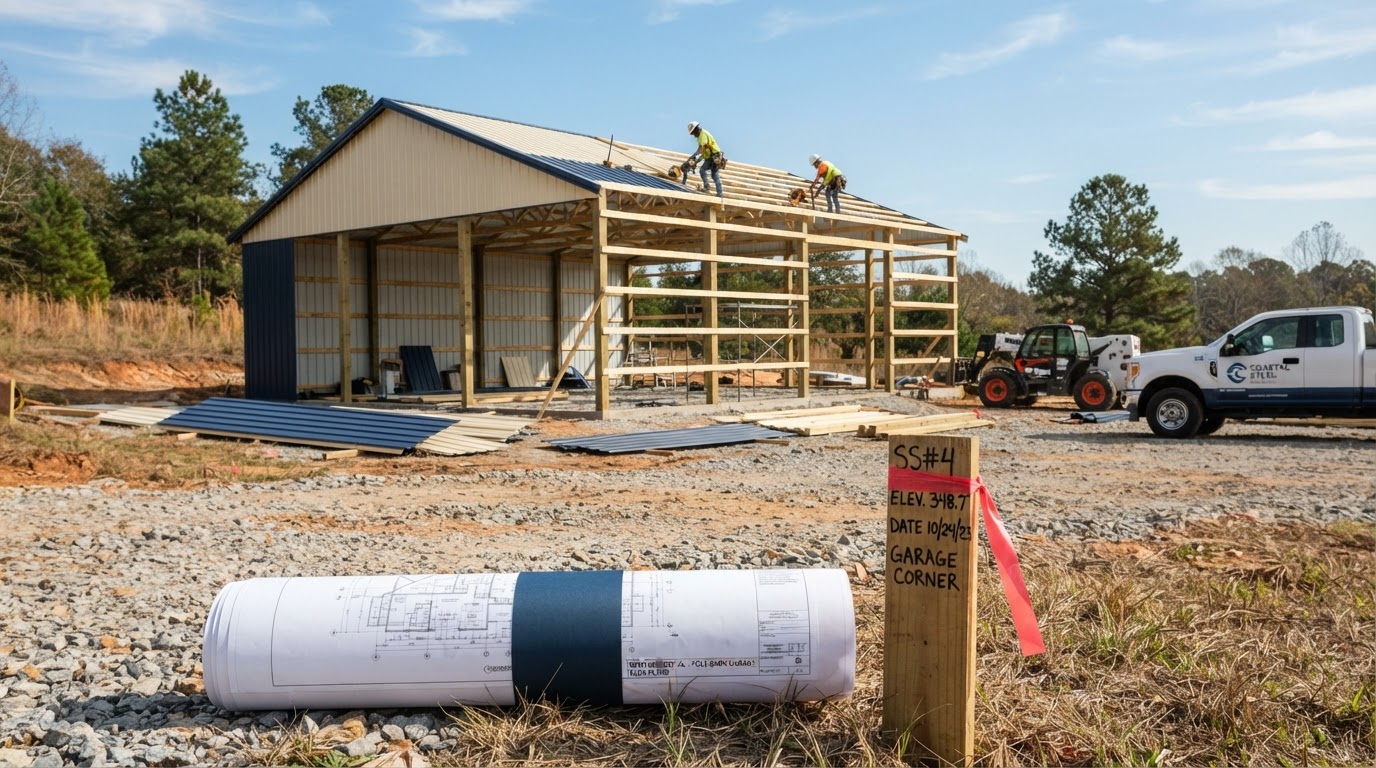
Commercial Metal Buildings
Commercial structures commonly fall under general contractor licensing depending on scope and value.
Alabama Licensing Resource
Contractor licensing is one of the most confused topics in metal building projects. Calling a structure a "pole barn," "metal garage," or "agricultural building" does not decide the licensing question. This guide explains how Alabama licensing may apply — and how to verify the actual requirement for a specific project.
The answer depends on the project type, building use, contract scope and value, who undertakes or supervises the work, the applicable licensing statutes, and other jurisdictional requirements. Naming a structure a "pole barn," "metal garage," "shop," or "agricultural building" does not automatically decide the licensing question.
Contractor licensing is also distinct from building permits, zoning and land-use approval, design and engineering requirements, trade licensing, business licensing, and inspections. Each is a separate question, and a license from one board does not resolve the others.
General Contracting
The Alabama Licensing Board for General Contractors regulates general contractor licensing. Its requirements may apply to a range of metal building work:
Commercial structures commonly fall under general contractor licensing depending on scope and value.
Warehouse construction may trigger licensing depending on the project's classification and value.
Industrial metal building projects can raise licensing and specialty requirements.
Adding to a commercial building may be subject to licensing as commercial work.
Certain larger or more complex projects can trigger licensing regardless of building type.
Applicable specialty or subcontracting work may carry separate licensing requirements.
Commercial roofing, renovation, and repair scopes may fall under general contractor licensing.
Dollar thresholds, exemptions, and classifications must be checked against the board's current law and rules. Do not present a threshold or exemption as universal unless the current statutory source confirms its applicability to the described project. Pay particular attention to the board's October 1, 2026 changes to licensing exemptions, which updated certain exemption provisions — older summaries that predate those changes may no longer be accurate.
A contractor's license should be evaluated for the specific contracting entity and applicable scope — not simply a business name used for marketing. The party advertising the project, the website, the contractor signing the agreement, and the professionals providing specialized work may be different entities. Verify the actual legal business or person that will contract for the work.
Residential Licensing
The Alabama Home Builders Licensure Board regulates residential construction and improvement. Residential metal building work may intersect with its jurisdiction in several ways:
A barndominium used as a residence is residential construction and may fall under home builders licensing.
A shouse combining shop and living space — the residential portion is residential work.
Adding to a residence, including a residential metal building addition, may be residential work.
Buildings used or converted for habitation can trigger residential licensing and occupancy requirements.
Other residential work within the board's jurisdiction may apply depending on the project.
Carefully distinguish a detached storage or agricultural structure from a residence or structure containing living quarters. A general contractor credential does not automatically resolve every residential licensing question — residential work may require home builders licensing, and the residential use is what brings residential requirements, not the building's shape or framing.
Agricultural & Owner-Builder
Alabama's agricultural-building exemption language, where applicable, appears in the current Home Builders Licensure Board law and official guidance. The exemption has a defined scope, and it is not a workaround for other requirements:
The agricultural exemption applies to specific agricultural uses under the current statutory and administrative definitions and limitations. Not every building on rural land qualifies.
Adding a residence or other non-agricultural use can change the analysis. An agricultural storage barn and a barndominium are not the same licensing question.
A home builders licensing exemption does not necessarily remove building-permit, zoning, engineering, or applicable general contractor obligations. Each is separate.
Owner-builder provisions have conditions and cannot simply be claimed by a hired contractor or marketer. Claiming owner-builder status for work performed by a hired contractor can be improper.
The actual property use and contracting arrangement determine which requirements apply — not the label applied to the building.
Labeling a project a "farm building" is not a strategy for avoiding requirements. The actual use, the contract scope, and the responsible authorities determine what applies — and an exemption from one requirement does not exempt the others.
Verification Steps
A practical, step-by-step approach to confirming who is licensed for the work:
Identify the legal business or person proposing to contract for the work — not the marketing name.
Confirm the exact scope and whether residential or commercial licensing laws may apply.
Search the relevant Alabama board's official license records for the contracting entity.
Check current license status and the applicable classifications for the scope of work.
Verify additional trade licensing — electrical, plumbing, mechanical — where required for the scope.
Ask who obtains permits and coordinates inspections, and confirm that responsibility in the contract.
Confirm who is responsible for engineering or design documents when the project requires them.
Resolve unclear requirements with the relevant licensing board or permitting authority before contracting.
The party advertising a project, the lead-generation website, the contractor signing the agreement, and the professionals providing specialized work may all be different entities. This page does not imply that Montgomery Pole Barn Builders & Metal Building Construction directly performs, supervises, engineers, or contracts for every listed service. An inquiry is routed to help connect the project with the appropriate scope and parties — it does not verify a contractor's credentials.
Local Considerations
Projects in the City of Montgomery, Prattville, Wetumpka, Pike Road, nearby counties, and unincorporated areas may involve different local review processes. State contractor licensing and local project approval are separate questions:
The City of Montgomery has its own building inspections and permit processes for properties within city jurisdiction.
Prattville municipal requirements and unincorporated Autauga County considerations are investigated separately.
Wetumpka city requirements and rural Elmore County considerations can differ, including floodplain review.
The Town of Pike Road has its own building and planning departments with distinct review processes.
Nearby counties and unincorporated areas may have different local review and floodplain considerations.
State contractor licensing is separate from local permitting and zoning — confirm each with the responsible authority.
This page does not invent local permit offices, local licensing exceptions, approval timelines, or mandatory fees. Confirm the local process with the responsible municipality or county building department for the specific property.
FAQs & Official Sources
Common questions about licensing as it may apply to metal building projects in Alabama:
Review the current versions of these official Alabama licensing sources before relying on any licensing statement. Rules and exemptions change — confirm current law, effective amendments, classifications, thresholds, and scope with each board:
Educational reference only — not legal advice. If sources conflict or a specific requirement cannot be confirmed, do not rely on an assumed answer. Resolve the question with the relevant licensing board or permitting authority before contracting. A "last-reviewed" date is added only after current official sources have actually been checked.
Plan Your Project
Describe the intended use, location, and approximate scope so the inquiry can be routed appropriately. This page is not a legal advisory service, and an inquiry does not verify a contractor's credentials — licensing questions must be confirmed with the responsible Alabama board.
No telephone number is published until verified for public listing. Email inquiries are monitored continuously.