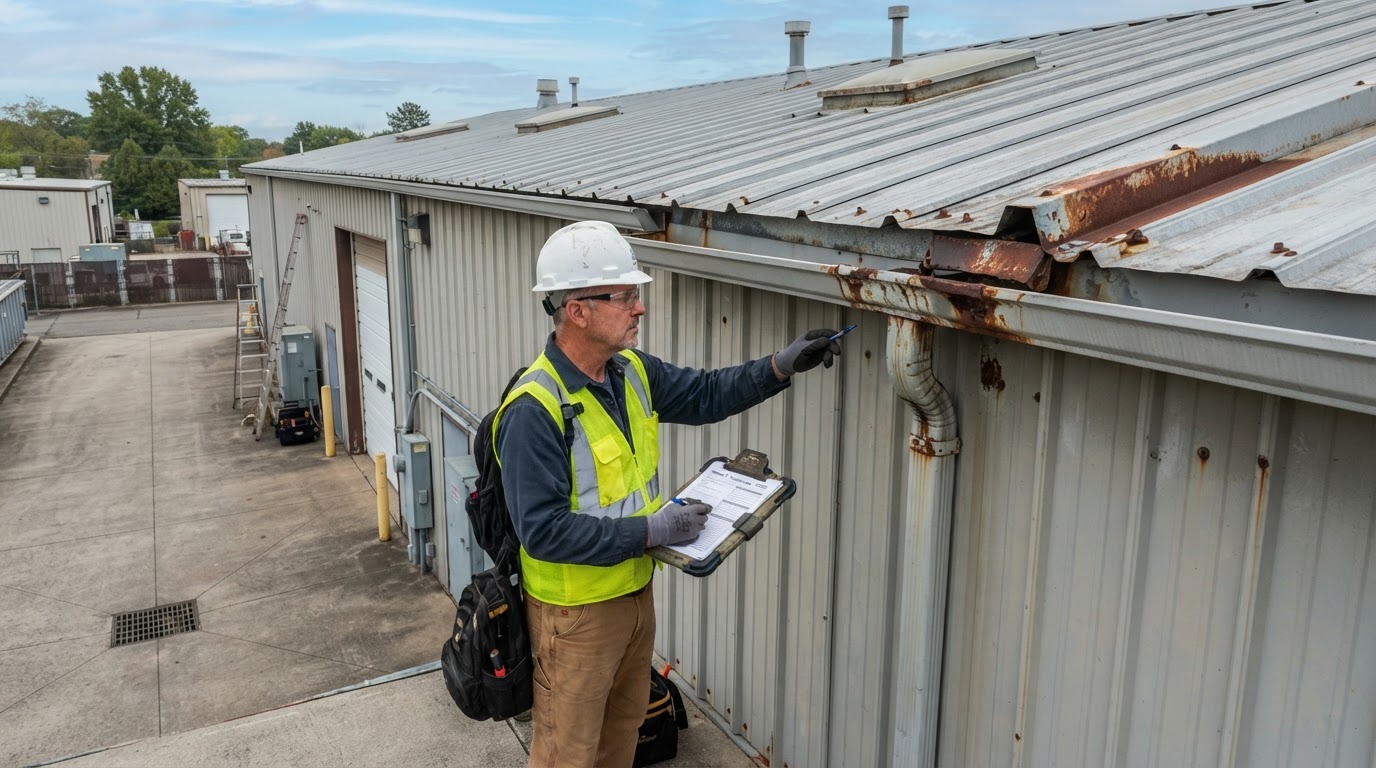
Metal Roof Panels
Panels checked for corrosion, coating failure, damage, and the condition that drives a repair-or-replace decision.
Commercial Metal Building Inspections & Maintenance
A routine condition assessment identifies the deterioration and the operational issues a commercial metal building has developed — the roof, the fasteners, the drainage, the corrosion, the doors, and the structural concerns — and frames the maintenance and the repair decisions that follow from what the building actually shows. A visual review is not a certified engineering inspection, and no formal code-compliance certification is claimed here without verification; where the review surfaces apparent structural concerns, the qualified assessment it calls for is recommended rather than assumed. The scope is confirmed for the actual building rather than read off a standard.
Components Requiring Attention
A maintenance review looks at the building as a system — the parts that keep water out, hold the building up, and keep it working — and documents what it finds.
Panels checked for corrosion, coating failure, damage, and the condition that drives a repair-or-replace decision.
Fasteners checked for backing-out, corrosion, and failed seals — a common entry point for water.
Flashing at penetrations, edges, and valleys checked for separation, corrosion, and failed seals.
Gutters, downspouts, and drainage paths checked for blockage, damage, and proper water movement.
Wall panels checked for corrosion, damage, fastener condition, and the weather-tightness of the cladding.
Rust anywhere it appears — surface, at fasteners, or on structural members — documented for what it is.
Doors checked for operation, seal condition, track and hardware wear, and weather-tightness.
Seals at doors, windows, and joints checked for failure, gaps, and the need for resealing.
Visible connections checked for corrosion, movement, or damage — flagged for qualified assessment where apparent.
Foundations checked for visible movement, cracking, or settlement — flagged for qualified assessment where apparent.
Insulation and condensation checked for moisture, saturation, and the conditions that cause dripping or mold.
Any damage from past storms — wind, hail, or impact — documented and flagged for the repair it needs.
Maintenance needs depend on the building's age, its exposure, its use, its construction, and its observed condition — a building in Central Alabama's heat, humidity, and storm exposure ages differently than one in a milder climate, and an older building or one with known issues has different needs than a newer one. The concerns the review surfaces follow the building and the conditions, and the maintenance plan is built from what the building actually shows rather than from a standard schedule.
Inspection & Assessment Planning
A condition review is a structured walk through the building's systems — documenting what it finds, separating routine maintenance from engineering investigation, and recommending the qualified assessment that apparent concerns call for.
Plans, drawings, age, and history reviewed to frame what the building is and what it has been through.
The leaks, the doors, the corrosion, or the damage the owner already knows about, documented as the starting point.
Roof and wall panels, fasteners, and flashing reviewed where they can be safely reached and observed.
Gutters, downspouts, and drainage paths checked for blockage, damage, and proper water movement.
Rust documented — where it is, how far it goes, and whether it appears to reach structural members.
Overhead doors cycled, seals and hardware checked, and the operation and weather-tightness documented.
Condensation, leaks, and wet insulation documented as the moisture problems the building is showing.
Visible movement, corrosion on load-carrying members, or damage flagged — not resolved, but identified.
Where the review surfaces structural or engineering concerns, the qualified assessment it calls for is recommended.
Routine maintenance — fasteners, seals, drainage, doors — separated from the engineering investigation the building may need.
No inspection certification is invented here, and a visual review does not establish structural safety — it documents what can be seen and recommends the qualified assessment where what it sees warrants one. The routine maintenance the building needs is separated from the engineering investigation, and the structural concerns are flagged for the professionals who evaluate them rather than resolved by the review.
Maintenance Planning & Repairs
The maintenance plan follows what the building shows — the repairs it needs now, the items to watch, and the larger work to plan for — built from the findings, not from a standard checklist.
Fasteners reseated or replaced and flashing repaired or replaced where the review found failure.
Leaks traced to their source and the repair that addresses the cause rather than the symptom.
Gutters and downspouts cleared, repaired, or re-pitched so water moves off the roof and away from the building.
Rust treated with materials compatible with the substrate, where the corrosion is surface rather than structural.
Damaged panels repaired or replaced where the metal, the coating, or the weather-tightness has failed.
Overhead doors serviced — hardware, seals, and operation — to restore reliable, weather-tight operation.
Insulation checked for saturation, settling, or damage and the conditions that affect thermal performance.
Condensation and dripping traced to ventilation, vapor, or insulation causes and the changes that address them.
Damage from past storms documented and the repair or the replacement it requires scoped.
Where the review shows a roof or a system that is failing broadly, the replacement or the retrofit is planned rather than repaired.
Maintenance intervals and procedures depend on the building system, the manufacturer's guidance, the conditions, and the actual findings — not a single schedule that fits every building. Routine maintenance does not prevent every failure; it addresses the issues the building shows and the work that extends service life where the structure and the systems support it. The plan follows the building, and the larger work is planned when the findings call for it rather than deferred or assumed away.
Inspection & Maintenance Questions
Questions a building owner asks before planning a commercial metal building inspection — answered for the decision, not for a sale.
Request a Condition Review
Share the facility type, the building dimensions, the known age, the current issues, the site location, any photos, any previous reports, and the desired scope. That frames a conversation about what the review will cover and what it will not — with the routine maintenance separated from the engineering investigation, and the next steps confirmed for the actual building.
No telephone number is listed until a verified contact number is supplied and approved for public display. Email is the fastest way to start a project conversation.