Loose or Worn Fasteners
Screws that back out, lose their washer seal, or sit in elongated holes — the most common source of metal roof leaks and often a straightforward repair.
Roof Repair
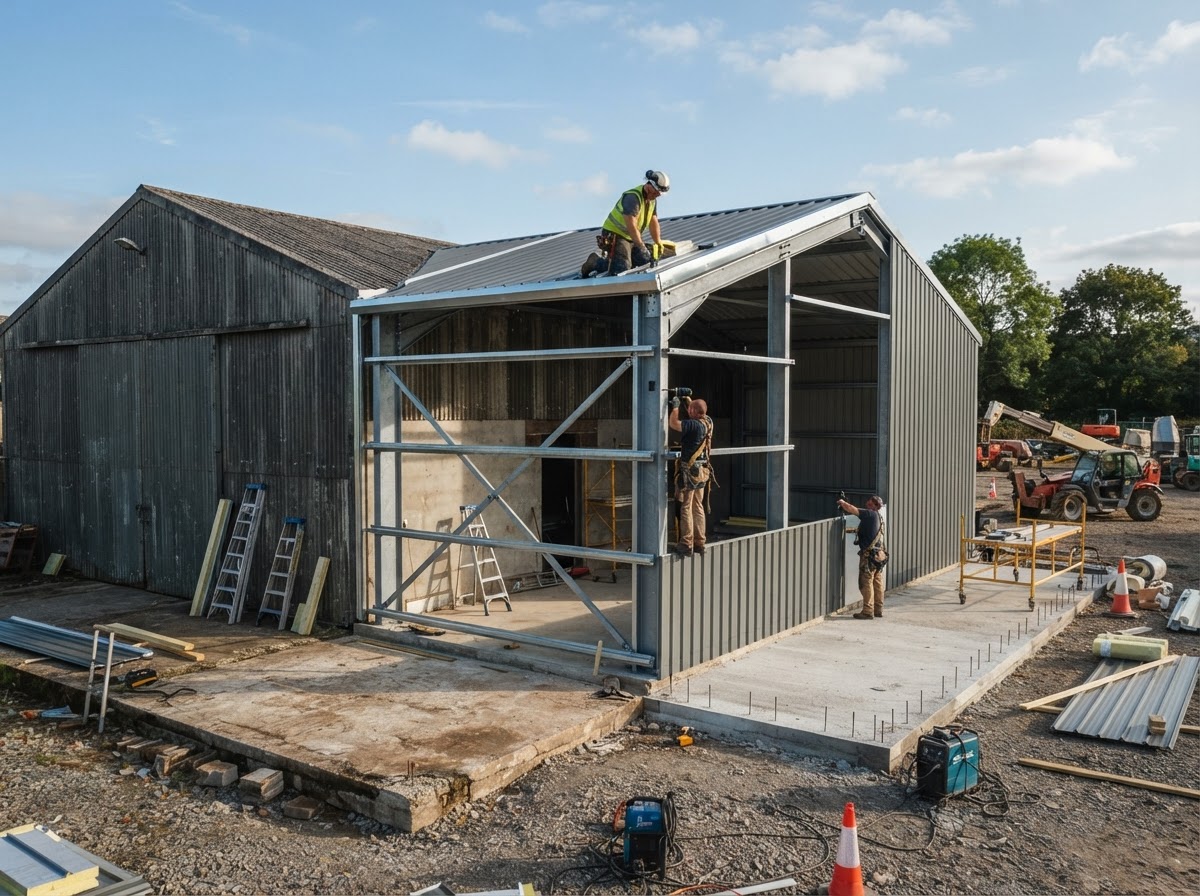
A leaking barn roof is usually a signal that something specific needs attention — and not always a sign that the whole roof has to go. The right repair depends on what is actually failing: a loose fastener, a flashing detail, a damaged panel, or corrosion that has reached the steel. This page covers how barn and metal-building roof problems are assessed on a Montgomery-area property and what repair options make sense when the roof still has useful life left in it.
Roof Problems
Most barn roof problems come from a handful of recognizable causes. Knowing which one is at work points to the right repair — and helps avoid replacing a roof that could still be fixed.
Screws that back out, lose their washer seal, or sit in elongated holes — the most common source of metal roof leaks and often a straightforward repair.
Panels dented by impact, wind, or hail, or cracked and punctured where the steel has fatigued, leaving the building exposed at the damage point.
Ridge caps, valley flashing, and penetration flashing that have pulled loose, dried out, or corroded — where edge leaks usually start.
Vents, stacks, and skylights where the seal around the opening has failed, letting water in at the roof's most vulnerable points.
Rust that starts where debris holds moisture against the steel or where the coating has worn, and that can thin the panels over time.
Wind-lifted panels, displaced flashing, or impact damage from debris that leaves the roof compromised after a severe-weather event.
Ridge vents, eave closures, and edge trim that no longer seal, letting wind-driven rain enter where the roof meets its edges.
Ponding water on a low-slope roof, clogged or undersized gutters, or runoff that undermines the roof edges and the building around them.
Leaks that come back after repairs — a sign the underlying problem was not found the first time, or that the roof is aging past repair.
Water that appears inside the barn may have entered somewhere else entirely. Wind-driven rain can travel along panel overlaps, run down purlins, or follow a fastener hole before it shows up as a drip. A stain on the underside of the roof does not mean the roof above that spot is the problem — it means water reached that point by some path. Finding the entry point is part of the assessment, and it is why a single visible stain does not mean the whole roof system has failed.
Assessment Process
A roof assessment works through the system in order so the repair follows what the roof actually needs — not a guess based on where the drip showed up.
Determine the roofing system — exposed-fastener or standing-seam, the panel profile, and how the roof is assembled.
Look at the panels for corrosion, thinning, damage, and how much useful life the roof surface has left.
Trace where water is getting in, recognizing that the entry point may not be above the visible drip.
Check the screws and washers for looseness, seal failure, and elongated holes that no longer hold.
Inspect the ridge, valleys, eaves, and the seals around vents, stacks, and other roof openings.
Identify panels that are dented, punctured, cracked, or fatigued and assess whether repair or replacement is appropriate.
Assess the extent of rust — surface corrosion that can be treated versus deeper corrosion that has thinned the steel.
Check the roof slope, gutters, and downspouts for ponding water or runoff that undermines the roof edges.
Where the structure beneath may be affected, evaluate the purlins and framing — the roof is only as sound as what carries it.
Determine whether the roof is best repaired or whether its condition warrants evaluating full replacement.
Roof inspections and repairs are performed by qualified people with appropriate access and equipment. No unsafe roof-climbing or do-it-yourself repair instructions are provided here — the assessment is about identifying what the roof needs, not climbing up to attempt it yourself.
Repair Options & Limitations
The repairs below address specific, localized problems on a roof that is otherwise sound. Which one applies depends on what the assessment finds — and a coating or sealant is never a substitute for correcting a structural defect.
Resetting or replacing loose fasteners with compatible screws and washers, and resealing the penetrations where the old seal has failed.
Treating a damaged or corroded panel in place where the surrounding roof is sound — sealing, patching, or reinforcing the affected area.
Re-securing or replacing ridge, valley, and eave flashing where edge leaks originate, with proper overlap and sealing.
Re-sealing the joints around vents, stacks, and skylights where the opening has lost its weather seal.
Evaluating whether corrosion is surface-level and treatable or whether it has thinned the steel past the point of repair.
Removing and replacing individual panels that are beyond repair, matched to the existing profile and fastener pattern.
Using sealants and tapes compatible with the roof material and the joint being repaired — not a generic coating applied everywhere.
Addressing ponding water or runoff problems at the roof edge that contribute to leaks, separate from the panel repair itself.
Repair corrects a specific, localized problem on a roof that is otherwise sound. It is distinct from a full roof replacement, which removes and replaces roofing that is failing broadly, and from a roof coating, which adds a surface system to a suitable existing roof. A coating or sealant applied over a structural defect, a failed fastener, or an unsuitable roof condition does not correct the underlying problem — it covers it. Where the roof is past repair, replacement is the honest answer rather than a repair that will not hold.
Repair Questions
Straightforward answers about leaks, fasteners, corrosion, and when repair is the right call.
Request a Quote
Share the structure type, the approximate roof or building size, the visible issue, the roof age if known, the property location, and any photos you have. That is enough to start a useful conversation about the assessment, the repair options, and whether the roof is worth repairing or better replaced.
No telephone number is listed until a verified contact number is supplied and approved for public display. Email is the fastest way to start a project conversation.
Related topics — rusty barn roof replacement and leaking roof screws — have their own pages as the site is built out.
Montgomery Pole Barn Builders & Metal Building Construction